Specializations
Understanding the psychological and behavioral mechanisms underlying distress can be an important step toward meaningful change. The following information explores common manifestations of obsessive-compulsive phenomena, anxiety, phobic avoidance, and trauma-related distress, alongside the counseling and behavioral support services available through Transformative Behavioral Solutions.
Information about psychiatric disorders and established psychotherapeutic treatments is provided for educational purposes and does not constitute diagnostic evaluation or an offer of independent psychotherapy.

OCD is frequently misunderstood. It is not simply a preference for order or cleanliness. It is a disorder of doubt, threat, urgency, and false responsibility that can consume extraordinary amounts of time and emotional energy.
For many people, OCD feels less like a single fear and more like an endless demand for certainty. The mind insists that something may be wrong, dangerous, immoral, incomplete, contaminated, or unresolved, then refuses to let go until you do something to feel better. Relief may come briefly, yet it rarely lasts. Soon the doubt returns, often stronger than before.
Many clients are surprised to learn that OCD can look nothing like the stereotypes. It may involve hours of invisible mental rituals, repeated reassurance-seeking, avoidance of ordinary situations, confessing, researching online, replaying memories, monitoring bodily sensations, seeking the “right” feeling, or trying to become completely certain about questions that cannot be solved with certainty.
Common presentations include:
Contamination fears
Checking rituals
Intrusive violent or sexual thoughts
Relationship OCD
Scrupulosity
Health anxiety features
“Just right” sensations
Mental rituals and reassurance-seeking
You may recognize yourself in experiences such as these:
rereading messages to make sure nothing inappropriate was said
needing repeated reassurance that you are not a bad person
Doubting whether you truly love your partner
Feeling unable to leave the house without checking locks or appliances
mentally reviewing past events for proof
avoiding knives or sharp objects despite no desire to harm anyone
washing long after you know you are already clean
Feeling deeply unsettled until something feels exactly right.
OCD often attacks what matters most. People who care deeply about morality may develop scrupulosity. Loving partners may become trapped in relationship doubt. Responsible people may feel crushing fear about causing harm. The content can vary widely, but the underlying cycle is remarkably consistent.
Exposure and Response Prevention (ERP) is widely recognized as a first-line psychotherapeutic treatment for OCD. This approach involves systematically confronting distress-provoking stimuli while reducing compulsive responses, allowing individuals to develop greater tolerance for uncertainty and new patterns of responding to intrusive experiences.
My OCD-focused counseling services draw upon principles of ERP, CBT, and ACT to facilitate psychoeducation, recognition of obsessive-compulsive patterns, uncertainty tolerance, psychological flexibility, and behavioral skill development.
I offer individualized behavioral support both as an adjunct to specialized OCD psychotherapy and as a standalone counseling service for individuals whose needs fall within my scope of practice. For clients engaged with a licensed treatment provider or structured treatment program, I provide complementary behavioral scaffolding designed to reinforce therapeutic objectives and bridge the gap between the clinical setting and everyday life. This may include facilitating the implementation of prescribed exposure exercises, reinforcing response prevention strategies, monitoring behavioral patterns, and promoting the generalization of acquired skills across environments. For individuals not currently engaged in psychotherapy, I provide one-on-one counseling and behavioral skill development focused on navigating distress, modifying maladaptive behavioral patterns, cultivating uncertainty tolerance, and strengthening functional autonomy. All services are provided in accordance with Washington State's statutory scope-of-practice, referral, and consultation requirements.
OCD can create the impression that certainty must precede action, that distress must be resolved before life can resume, and that intrusive thoughts must be understood before they can be relinquished. Developing a different relationship with these experiences can create space for greater autonomy, flexibility, and engagement in meaningful activities.
Progress does not require perfect confidence or the complete absence of fear. It begins with cultivating the willingness to respond differently, even in the presence of uncertainty.

Although obsessive-compulsive phenomena and anxiety disorders share certain psychological and behavioral features, they frequently involve distinct mechanisms. OCD is often characterized by intrusive experiences and compulsive attempts to neutralize distress, resolve uncertainty, or prevent feared outcomes. Other anxiety-related presentations may be characterized more prominently by persistent worry, panic sensations, fear of negative evaluation, heightened threat sensitivity, or avoidance of situations perceived as dangerous. Understanding these distinctions can help individuals recognize the behavioral patterns that contribute to distress and better understand the forms of professional support available to them.
For some, anxiety appears as relentless worry that moves from one topic to the next and rarely allows genuine rest. The mind remains preoccupied with future problems, worst-case scenarios, responsibilities, finances, health, relationships, or decisions that feel impossible to settle. For others, anxiety arrives in surges of panic marked by racing heart, shortness of breath, dizziness, trembling, derealization, chest discomfort, or the fear that something catastrophic is about to happen.
Some clients feel constrained by intense fear of judgment, embarrassment, rejection, or scrutiny in social settings. Conversations become stressful, performance situations feel overwhelming, and ordinary interactions can carry disproportionate emotional cost. Others struggle with highly specific fears tied to driving, flying, vomiting, needles, enclosed spaces, contamination, animals, heights, storms, elevators, or other situations they know are manageable in theory yet difficult to face in practice.
Common presentations include:
Generalized and anticipatory anxiety
Panic attacks and fear of physiological sensations
Social and performance anxiety
Agoraphobic avoidance
Specific phobias
Health-related anxiety
Maladaptive perfectionism
Heightened threat sensitivity
You may recognize yourself in experiences such as these:
Declining invitations because social situations feel draining
avoiding highways after a panic attack
repeatedly seeking reassurance about health concerns
overpreparing for routine tasks out of fear of mistakes
postponing important decisions until certainty feels possible
sitting near exits in public places,
carrying “just in case” items everywhere
structuring daily life around the prevention of anxiety rather than the pursuit of meaning.
My anxiety-focused counseling services emphasize the recognition of avoidance patterns, development of adaptive coping strategies, enhancement of distress tolerance, and cultivation of greater confidence in navigating challenging situations.
Drawing upon principles of Cognitive Behavioral Therapy (CBT), Acceptance and Commitment Therapy (ACT), Dialectical Behavior Therapy (DBT), Mindfulness-Based Cognitive Therapy (MBCT), Interoceptive Exposure (IE) and Exposure Therapy (ET), counseling emphasizes practical skill development and purposeful behavioral change.
I offer individualized behavioral support both as an adjunct to specialized anxiety treatment and as a standalone counseling service for individuals whose needs fall within my scope of practice. For clients engaged with a licensed treatment provider or structured treatment program, I provide complementary behavioral scaffolding to reinforce established therapeutic objectives and facilitate the translation of acquired skills into everyday environments.
This may include supporting prescribed exposure exercises, reinforcing adaptive responses to physiological arousal, facilitating adherence to established behavioral objectives, and monitoring patterns of avoidance and safety-seeking. For individuals not concurrently engaged in psychotherapy, I offer one-on-one counseling focused on cultivating distress tolerance, strengthening self-efficacy, and developing greater behavioral and psychological flexibility.
The goal is not necessarily to eliminate every anxious sensation, but to cultivate a relationship with fear in which discomfort does not automatically dictate the boundaries of one's life. Confidence need not depend upon the absence of anxiety; it can emerge through the capacity to move forward without waiting to feel perfectly certain or comfortable.
Fear can become smaller. Life can become larger.
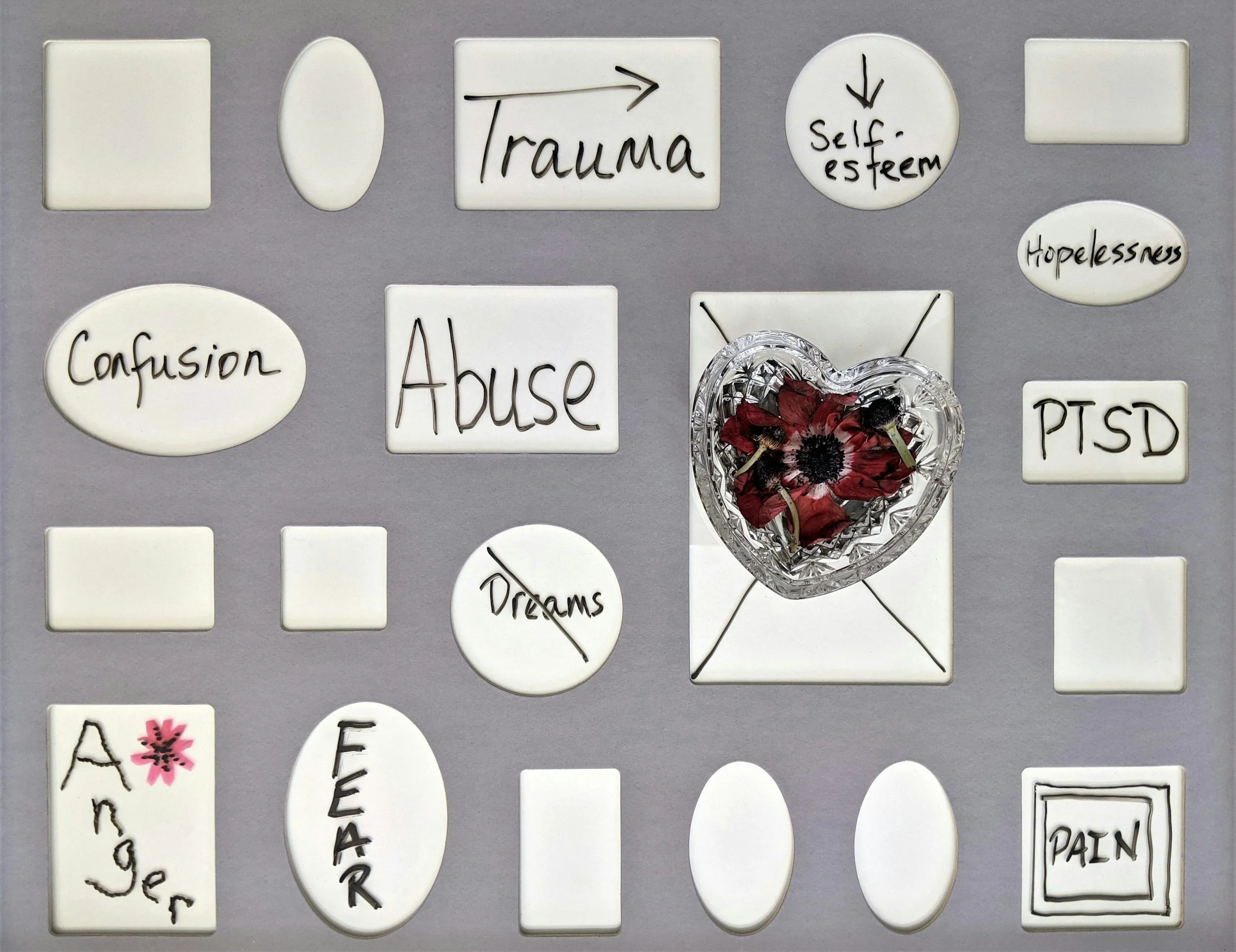
Trauma can persist in the nervous system long after danger has ended. Many clients carry hypervigilance, shame, emotional numbing, distrust, self-blame, or patterns that once ensured survival but now create suffering.
For some, trauma remains vividly present through intrusive memories, nightmares, physiological reactivity, flashbacks, or the sense that the past is still happening now. For others, it appears in quieter forms: emotional disconnection, difficulty trusting others, chronic guilt, irritability, avoidance of reminders, collapse responses, or a persistent expectation that danger is always near.
Trauma often reshapes identity as much as it affects symptoms. People may begin to see themselves as broken, permanently damaged, responsible for what happened, unworthy of care, or incapable of feeling safe again. Relationships can become strained. Opportunities may be avoided. Life can narrow around protection rather than growth.
Many survivors also struggle with the confusing reality that trauma responses once made sense. Hypervigilance may have helped you detect danger. Emotional numbing may have reduced overwhelm. Distrust may have been protective. The problem is not that these responses developed; it is that they can continue long after they are no longer needed.
Common manifestations include:
Hypervigilance and heightened physiological arousal
Intrusive memories and nightmares
Emotional numbing and dissociation
Persistent shame and self-blame
Interpersonal and attachment-related difficulties
Emotional dysregulation
Heightened sensitivity to perceived threats
Trauma-associated avoidance
You may recognize yourself in experiences such as these:
Feeling on edge even in safe environments
startling easily
scanning rooms for exits
replaying painful memories
withdrawing from people who care about you
Feeling detached from your own emotions
Blaming yourself for another person’s actions
struggling with intimacy
Becoming overwhelmed by reminders that others would barely notice
Feeling frustrated that you “should be over it by now.”
Trauma-informed counseling recognizes the profound influence that adverse experiences can have on emotional regulation, interpersonal relationships, perceptions of safety, and everyday functioning. It emphasizes autonomy, collaboration, emotional safety, and respect for the individual's readiness to engage in meaningful behavioral change.
My trauma-informed counseling services focus on strengthening coping capacity, developing grounding strategies, enhancing emotional regulation and distress tolerance, cultivating healthy interpersonal boundaries, and supporting greater stability in daily life.
Drawing upon principles of CBT, ACT, DBT, and mindfulness-based approaches, counseling emphasizes the acquisition of practical skills that help individuals navigate present-day challenges and develop greater awareness of their emotional and behavioral responses.
I offer individualized behavioral support both as an adjunct to specialized trauma-focused psychotherapy and as a standalone counseling service for individuals whose needs fall within my scope of practice. For clients engaged with a licensed treatment provider or structured treatment program, I provide complementary behavioral scaffolding designed to reinforce therapeutic objectives and facilitate the integration of acquired skills into everyday life.
This may include reinforcing grounding techniques, emotional regulation strategies, interpersonal effectiveness skills, and adaptive behavioral responses. For individuals not concurrently engaged in psychotherapy, I provide one-on-one, present-focused counseling emphasizing functional stability, psychological flexibility, interpersonal boundaries, and the restoration of personal autonomy.
Individuals requiring specialized trauma-processing psychotherapy, including Cognitive Processing Therapy (CPT) or Prolonged Exposure (PE), are referred to appropriately licensed mental health professionals. All counseling services are provided in accordance with applicable statutory scope-of-practice, referral, and consultation requirements.
The intention is to foster greater autonomy and engagement in the present, allowing individuals to develop capacities that support a life guided increasingly by personal values rather than protective patterns alone.
Healing need not mean forgetting what happened. It can involve reclaiming the capacity to envision possibilities beyond it.